
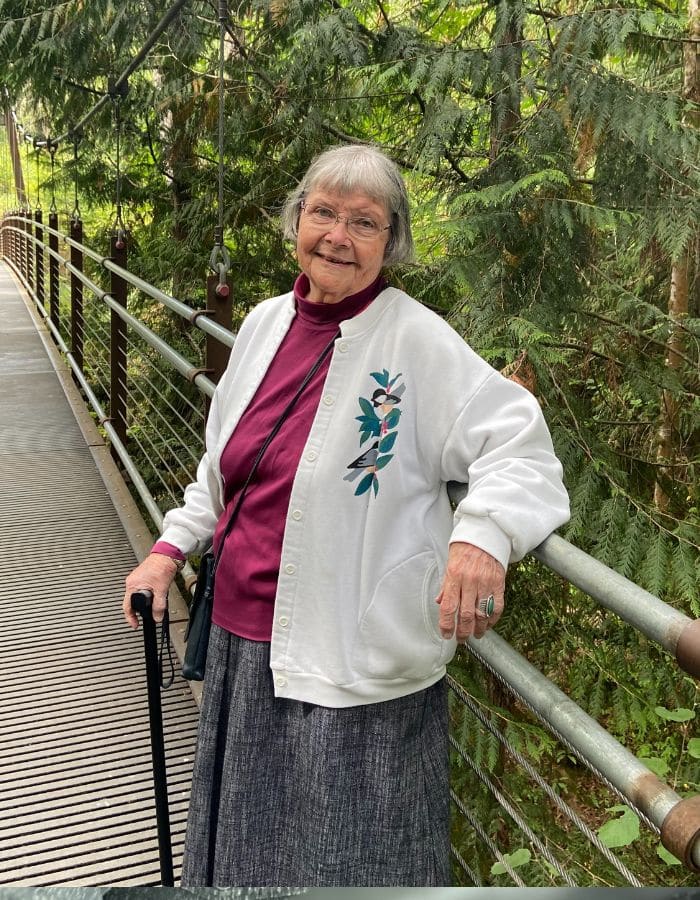


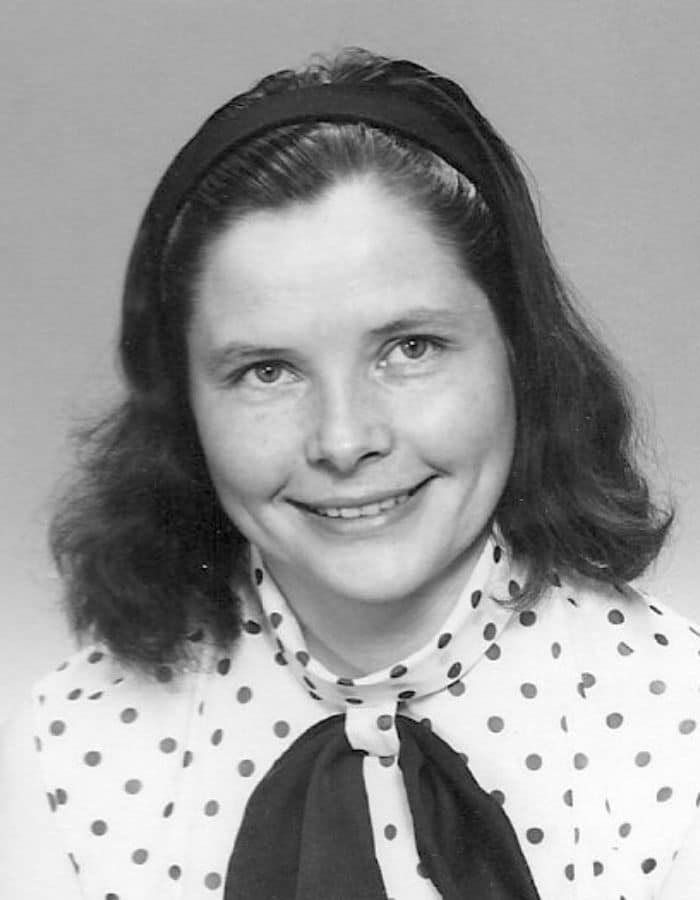


Inge Clara Luise Floss, née Säuberlich
April 30, 1934 – April 6, 2025
Inge Clara Luise Floss, née Säuberlich, was a beloved wife, mother, and grandmother, and an inspiring person. She was born on April 30, 1934 in Berlin, Germany, the only child of Ernst and Elisabeth Säuberlich. During the World War II bombings of Berlin, she and her mother spent several years living ‘close to nature’ in Fahlhorst, a tiny village outside the city, where both of her parents were from and where both sets of Inge’s grandparents and numerous other relatives lived. Afterwards the family returned to Berlin, and as the city returned to stability, so did Inge’s personal life.
As she grew up, her mother often said to her, “Du willst wohl was besseres sein,” which translates to the effect of, “You probably want to be something better.” In Inge’s memoir, this is recorded a little chidingly, whenever her mother thought she was reaching “beyond [her] station in life,” but it proved to be an insightful truth. Inge did, persistently, want to be something better than she was, and she worked—quietly, diligently, consistently—to achieve that.
Due to financial constraints and practical expectations, her parents were unenthusiastic about supporting her through college-bound high school, and university was entirely out of the question. Instead, Inge attended a business school and trained for office work. This redirection was initially a great disappointment for her, but made up for itself when a new friend from the business school invited Inge out for a bicycle ride with two young men–one of whom, Heinz-Günter Floss, turned out to be the love of Inge’s life.
Because the Floss family was better off than the Säuberliches, Inge’s parents worried that she was, with this relationship, once again ‘wanting to be something better’ than she was. But Inge and Heinz-Günter knew a good thing when they found it, and, as Inge put it, “I was game, if he was.” The challenge of something never deterred her. They married in 1956, in Steglitz-Berlin, and set about making the next sixty-six years ones to remember.
They moved to Munich in 1961 to continue Heinz-Günter’s PhD studies, then immigrated to the United States in 1966, first settling in West Lafayette, Indiana, and later making their permanent home in Bellevue, Washington.
Inge was self-effacing, so she was disinclined to take the credit due her in her husband’s exceptional scientific career, but when it became clear that he would benefit from having someone performing critical behind-the-scenes work on his behalf, Inge turned herself into an asset. She learned how to cater dinners and parties and vast Christmas cookie platters for entire science departments, how to host important colleagues from around the world, and she accompanied him whenever he went, simply because he always wanted her with him.
In the midst of all this, as well as the work of keeping an immaculate house, Inge also bore and raised four children—Christine, Peter, Helmut, and Hanna. She was a devoted and caring mother, whose nurturing ranged from reading aloud all manner of books, to sending her children into squeals with finger-play songs like ‘Geht ein Mann die Treppe rauf.’ She cultured them with travels around the world, taught them both German and English, and instilled in them a wide variety of life skills—even how to make butter.
Later on, Inge likewise enjoyed spending time with her grandchildren and great-grandchildren. She was especially beloved for her skills in the realm of Streuselkuchen, pizzelles, Marzipanbrotchen, and Marmorkuchen. She read to them often when they were small, and kept enough of a formidable edge that they knew better than to leave their dinners uneaten. Her delighted chuckles, cozy accent, and famous striped dresses (respectively blue and pink) were essential aspects of her Oma-ness. And, as with her children, when a topic cropped up in conversation with a grandchild—a new quilting hobby, a painter from Inge’s travels, a poet she admired—Inge frequently followed the conversation up with a handful of relevant books or an email that encouraged the interest along. She believed in helping her progeny become something better too.
Inge continuously worked to learn more and become better—for her family’s benefit, but also for her own. When good German bread proved difficult to find in the United States, she learned how to bake. When she wondered if she could grow an avocado tree from a supermarket avocado pit, she planted one and grew it. When she became interested in textile arts, she learned how to weave—creating beautiful artworks that her husband was convinced could have found a market if she’d wanted them to. And equipped with relentless curiosity, Inge gave herself the university education she missed out on as a young adult. She loved books almost as much as she loved her family, she read deeply and widely, and was impressively knowledgeable about literature, cultures, art, and history from all around the world. At ninety years old, she still spent time every day reading her beloved and renowned Japanese poet Matsuo Bashō and philosophies of major world religions—all in her second language.
Inge and Heinz-Gunter travelled the globe, seemingly always returning from or planning their latest international excursion. She retained childlike wonder and whimsy for the world, and she saw the beauty and importance of all things nature. Inge loved garden walks and the tall majestic trees of the Pacific Northwest. She was adamantly against violence and believed in the importance for all beings and creatures to live their lives as unrestricted as possible. Inge was kind, caring, and determined, and eschewed the arrogance of mankind. Inge was a good human being.
Humble and grateful to the end, she wrote in her memoir, “My life turned out as wonderful as I could have wished for and better than I deserve.”
She is survived by her sons Peter (Barbara) Floss and Helmut Floss; her daughter Hanna (Tony Andrews) Floss; grandchildren Alisha (Jeff) Hillam, Ashley (Jeremy) Jewell, Brian (Kristiana) Floss, Michael (Tia) Floss, Maggie Yuse, Amanda (Daniel Musselwhite) Stadermann, Benjamin (Sabrina McGraw) Yuse, Elizabeth Andrews, and Tyler (Emily) Andrews; and great-grandchildren Minnie Hillam, Ezra Hillam, Ruby Hillam, Elise Andrews, and Cooper Andrews. She is preceded in death by her parents, Emilie Marie Elisabeth Säuberlich née Basdorf and Ernst Reinhold Säuberlich, her son-in-law Frank Johannes Stadermann, her daughter Christine Floss, and her beloved husband, Heinz-Günter Gottfried Floss.
In lieu of flowers, the family suggests a donation in Inge’s memory to the Bellevue Botanical Gardens where she and Günter walked regularly.