
Is all human composting soil the same quality?
No. There can be a significant difference in the quality of soil produced from human composting. Soil quality directly impacts its ability to support healthy plant growth and overall soil health. Factors such as nutrient availability, pH balance, and microbial stability all contribute to its effectiveness. Recompose is proud to pioneer this field and lead […]
What is the difference between terramation and human composting?
Technically, there is no difference between terramation and human composting. These terms, along with soil transformation, recomposition, and natural organic reduction, all refer to the same process of turning human remains into nutrient-rich soil. The key difference between terramation and the other terms lies in branding and terminology–terramation is a branded name for human composting […]
What is human composting?
Human composting, also called natural organic reduction or soil transformation, is a form of disposition that transforms a body into soil.
What is tree pod burial?
Tree pod burial has garnered a lot of buzz in the last few years. However, at this point it is just a concept rather than an actual and available form of death care.
What are other names for human composting?
Human composting is called natural organic reduction, soil transformation, recomposting, recomposition, terramation. Know more with Recompose.
How can I help make human composting legal in my state?
In the U.S., the laws governing human remains vary greatly from state to state. Learn more about how you can contribute towards expansion.
How can human composting soil be used?
The soil created by human composting is nourishing for trees and plants. Learn more about how Recompose customers have used the soil.
How does alkaline hydrolysis compare to human composting?
Like human composting, alkaline hydrolysis is a process for transforming a body after death. Learn more about the differences & similarities.
How does human composting compare to green burial?
Green burial is the practice of burying a body in a green burial cemetery with a casket. Learn about about green burial vs human composting.
Is cremation environmentally friendly?
Cremation uses fossil fuels, and emits carbon dioxide and toxic particulates into the atmosphere. Learn more about why human composting is more eco-friendly than cremation.
How does human composting reduce your carbon footprint?
Human composting saves carbon as it uses less energy than cremation. Learn more about the positive environmental impact of human composting.
How does a human composting vessel work?
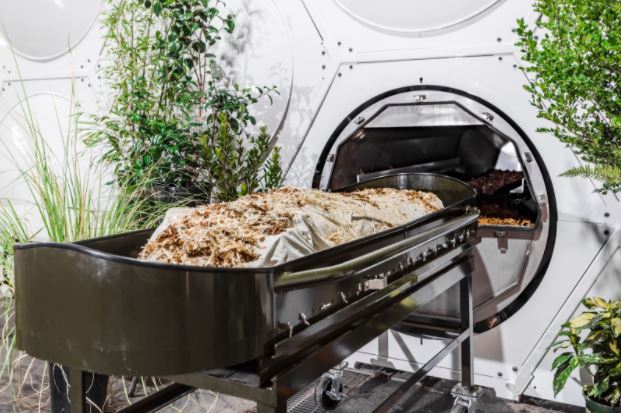
At Recompose, the human composting takes place in a vessel. Learn more about the steel cylinder and the process of composting.
What happens to artificial limbs or tooth fillings during human composting?
Non-organics like metal fillings, prostheses, and artificial joints are recycled if possible. Learn more about human composting.
What happens to drugs and medicine during human composting?
Human composting eliminates disease pathogens and parasites. Learn more about the sustained heat that removes toxins from the body.
What happens to diseases during human composting?
Human composting eliminates diseases. Learn more about how the heat during the process ensures the soil created is free of harmful pathogens.
How long does human composting take?
The human composting process generally takes between eight to twelve weeks. Learn more about human composting.
How does human composting work?
Human composting is the transformation of a human body into soil. Learn more about the process followed at Recompose.
Where is human composting legal?
Human composting is now legal in more than a dozen states. Learn more about the legalization of human composting.
Why is human composting more eco-friendly than burial or cremation?
Human composting is environment-friendly because the process does not use fossil fuel like cremation. Learn more about ecological death care.
What happens to bones and teeth during human composting?
Bones and teeth do not fully break down in the human composting process due to the mineral composition. Learn about how they are broken down.
How does the cost of human composting compare to other options?
The cost of Recompose is comparable to conventional funeral options like burial and cremation.